

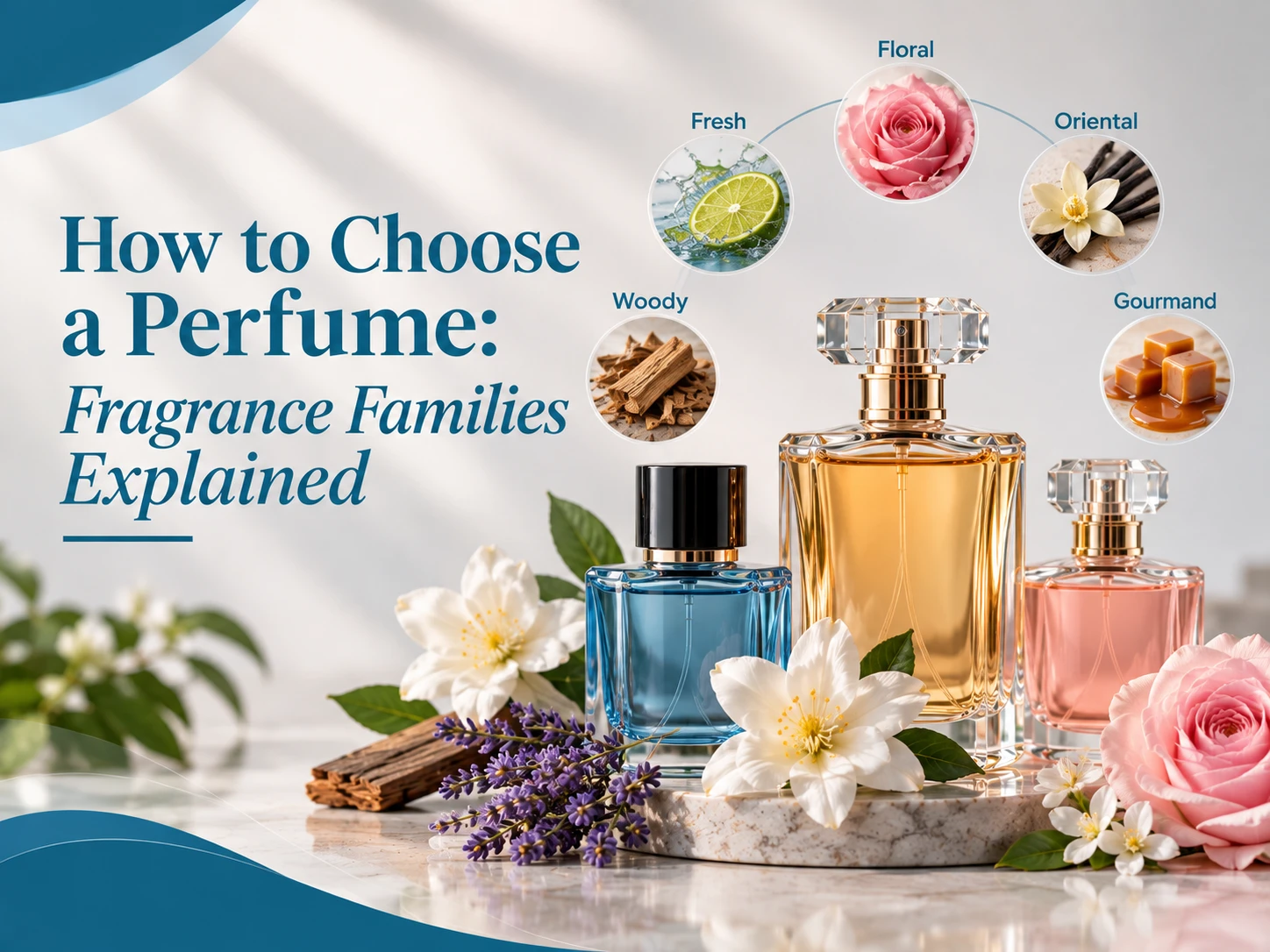
The easiest way to choose a perfume is to start with a fragrance family, not a bottle. Fragrance families group scents by their dominant character: floral, woody, amber and fresh. Instead of working through hundreds of names, you test a few directions and follow the one that feels like you. Once you know your family, every choice after it gets smaller: which notes, which strength, which season. This guide explains what each family smells like, how to match it to the time of year and the moment you'll wear it, and how to test a scent properly before you commit to a full bottle.
Key takeaways
- Start from smells you already like, then narrow to one or two fragrance families.
- The four main families are floral, woody, amber and fresh; gourmand, chypre and fougère are branches of these.
- Judge a perfume after it has dried down on your skin, not on the first spray.
- Heat makes scent fade faster, so the family that suits you in winter may feel heavy in August.
- Men's and women's labels describe a style, not a rule. Wear what smells right on you.
How to choose a perfume in four steps
If you only read one section, read this one.
- Start from smells you already love. Not perfumes, smells. Fresh laundry, wet stone after rain, warm bread, cut grass, a rose garden. Each one points at a family.
- Narrow to one or two families. Use the comparison table further down. Two directions are enough for one session; four are too many to judge.
- Test on skin and wait. Spray, then leave it alone. A perfume you love in the first minute can become something else a few hours later, and that later version is the one you will actually wear.
- Match the strength to the moment. A scent for a summer afternoon and a scent for a winter evening do different jobs, even inside the same family.
Most people skip step three, buy on the opening, and end up with a bottle they wear twice. The family system exists to make step three quick enough that you do it.
What are fragrance families?
Fragrance families are groups of perfumes that share a dominant scent character, such as floral, woody, amber or fresh. They work like a map: instead of judging thousands of individual bottles, you narrow the field to the two or three directions that suit you, then explore inside them.
The model most retailers use today is the fragrance wheel created by the fragrance expert Michael Edwards. He designed it so shop staff could recommend something new based on what a customer already wore. It is laid out like a colour wheel: neighbouring families share traits and blend easily, while families on opposite sides contrast.
That layout helps when you choose. If you like a woody scent but want something lighter for summer, you move one step around the wheel rather than starting over. If you already own one perfume you love, its family tells you where to look next.
Four families or seven?
You will also see lists of seven families, especially in French and Italian perfumery: citrus, floral, fougère, chypre, woody, amber (oriental) and leather. This is the traditional French classification. It covers the same ground in finer slices, so there is no conflict: the four-family model is the quick way in, the seven-family list is the detailed version. Classification is not an exact science either. Most modern perfumes sit across two families, and the bottle rarely tells you which.
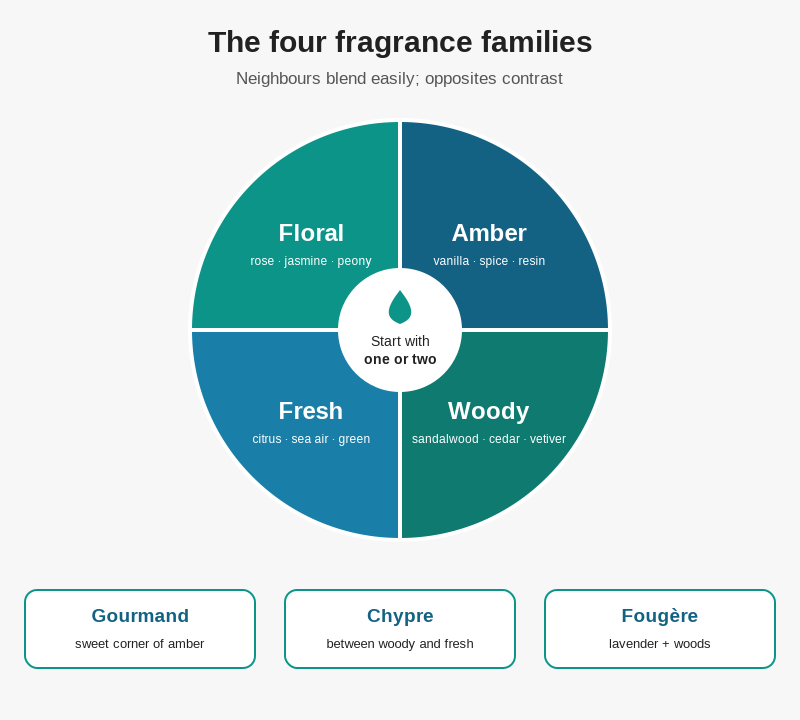
The four main fragrance families
Almost every classification starts from the same four. Everything else is a blend or a branch of these.
Floral
The broadest family. If a scent leads with flowers, it lives here, from a single soft rose to a dense bouquet. Floral covers such a range that "I don't like florals" usually means you met one loud floral, not the whole family.
- Smells like: a bunch of cut flowers, sometimes powdery or fruity
- Common notes: rose, jasmine, peony, lily, violet, orange blossom
- Consider it if: you want something easy to wear that feels soft rather than sharp
Woody
Warm, dry and grounded. Woody scents recall cedar shavings, dry earth and warm skin rather than anything sweet. They tend to sit close to the body and last well, which is why they are common in fragrances marketed to men, though nothing about the family is masculine by nature.
- Smells like: sawn timber, incense, wood warmed by the sun
- Common notes: sandalwood, cedarwood, vetiver, patchouli, oud
- Consider it if: you want something understated that stays close, and you dislike sweetness
Amber (also called oriental)
The richest family. Amber scents are warm, resinous and often a little spicy, built on ingredients that evaporate slowly. They are the most noticeable of the four and the least forgiving if you over-apply: one spray too many is obvious to everyone in the room.
- Smells like: a spice drawer, vanilla, warm resin, a faint trace of smoke
- Common notes: vanilla, amber, benzoin, cinnamon, cardamom, tonka bean
- Consider it if: you want presence, you wear scent mostly in the evening, or it's winter
Fresh
Light, clean and bright. Fresh covers citrus, aquatic and green scents, the family that reads as "just showered". The trade-off is staying power: the molecules that make a scent smell fresh are the same ones that evaporate fastest, so fresh perfumes often need a second spray later in the day.
- Smells like: lemon zest, sea air, crushed leaves, cold mint
- Common notes: bergamot, lemon, neroli, marine accords, basil, green tea
- Consider it if: you want something for daytime, the office, hot weather or a first perfume
Where gourmand, chypre and fougère fit
These three names come up constantly, and none of them is a fifth family. Gourmand is the edible corner of amber: vanilla, caramel, praline, coffee. Chypre is a classic structure with citrus at the top and mossy, woody depth underneath, sitting between woody and fresh. Fougère pairs lavender with woody and mossy notes and is the backbone of most traditional barbershop scents. When a sales assistant uses one of these words, they are describing a style inside a family.
Which fragrance family should you choose?
Use this table to pick your first two directions. Read the last column first; it is the fastest route to a shortlist. The examples are perfumes from our range, chosen to show what each family smells like in practice.
| Family | Smells like | Ideal season | Staying power | Example to smell | Choose it if |
|---|---|---|---|---|---|
| Floral | Cut flowers, soft, often powdery | Spring, early summer | Medium | Dior Miss Dior Blooming Bouquet | You want something easy that most people read as pleasant |
| Woody | Dry wood, earth, warm skin | Autumn, winter | High | Tom Ford Oud Wood | You want understatement and a scent that lasts without shouting |
| Amber | Spice, resin, vanilla warmth | Winter, cold evenings | Highest | Tom Ford Tobacco Vanille | You want to be noticed and wear scent mainly after dark |
| Fresh | Citrus, sea air, greenery | Summer, hot days | Lower | Tom Ford Neroli Portofino, Giorgio Armani Acqua di Giò | You want something light for daytime, work or heat |
| Gourmand | Sweet, edible, cosy | Autumn, winter | High | Tom Ford Lost Cherry | You are drawn to sweet, warm smells and want something distinctive |
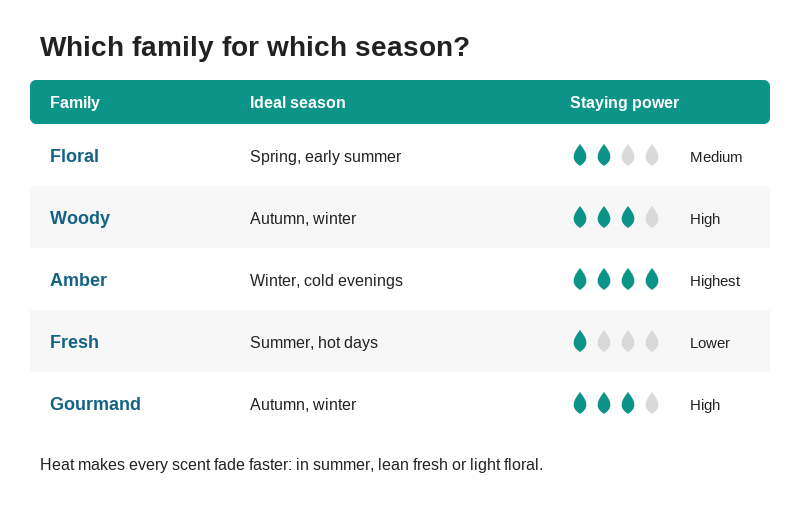
Match the family to the season, not just your taste
A perfume behaves differently on a hot August afternoon than on a cold January morning. Heat speeds up evaporation, so in summer a scent projects strongly at first and fades sooner. In cold weather it stays closer to the skin and lasts longer. The family that suits you in December may feel heavy in August, even though your taste hasn't changed.
- Hot, humid days: fresh and light floral scents feel comfortable; dense amber can become overwhelming on warm skin. Expect to reapply, and accept that as normal.
- Cool evenings and winter: amber, woody and gourmand scents come into their own and unfold slowly over hours.
- Air-conditioned offices: you smell your own perfume less indoors and are tempted to add more. The people around you are not in the same bubble.
- Dry skin: scent holds poorly on it. A layer of unscented body cream first gives the fragrance something to sit on and slows how fast it leaves.
This is why many people own a summer bottle and a winter bottle rather than one signature scent. It's the same reasoning that puts different shoes in your wardrobe.
Top, heart and base notes
A perfume is built in three layers that appear one after another rather than all at once. This structure is often drawn as the fragrance pyramid.
- Top notes are what you smell first. They are the lightest ingredients and disappear first, usually citrus and light herbs.
- Heart notes take over once the opening fades and carry the character of the scent. Most florals and spices live here.
- Base notes emerge last and stay longest, sometimes all day. Woods, resins, vanilla and musk sit here.
The shift from top to base is called the dry down, and it explains why a perfume smells different an hour after you spray it. When people say a fragrance "changed on me", it did what it was designed to do. They judged it too early.
Eau de parfum, eau de toilette and the rest
These names describe how concentrated the fragrance oils are. A higher concentration usually sits closer to the skin for longer; a lower one gives a brighter opening that fades sooner. Neither is better. An eau de toilette can be the smarter choice for a hot afternoon, an eau de parfum for a long evening. We compare the two in detail in our guide to eau de parfum vs eau de toilette.
How to test a perfume properly
Testing is where most bad purchases are prevented, and it takes one afternoon.
- Start with clean, unscented skin. Yesterday's perfume and a strongly scented shower gel both interfere.
- Test two or three at most. After the third, your nose stops telling them apart.
- Use paper strips for the first pass. Strips are for ruling out obvious misses quickly, nothing more.
- Move the finalists to skin. One on each wrist, one on an inner elbow. Paper can't tell you how a scent behaves on you.
- Don't rub. Rubbing your wrists together crushes the top notes and rushes the dry down.
- Go on with your day. Smell it again after an hour, then again in the late afternoon. The later version is what other people will notice most.
- Decide the next day. If you still want it in the morning, it's the right bottle.
Between two scents, smelling your own sleeve or forearm resets your nose better than coffee beans, which mostly add another strong smell.
How to choose a perfume online without smelling it
Every guide tells you to test on skin and then links to a checkout. The honest version: you can't fully judge a perfume online, but you can shorten the odds a lot.
- Anchor on something you already wear. Find the family and main notes of a perfume you like, then look for bottles that share both.
- Read the note list, not the marketing copy. The notes are information; the paragraph about moonlight and mystery is not.
- Read longevity reviews with care. Staying power depends on skin, climate and how much the reviewer sprayed. Reviews that describe the smell are more useful than scores.
- Check the ingredient list on the pack. EU cosmetics rules require certain fragrance ingredients to be listed when present above set levels, which is worth checking if you know one doesn't agree with you.
- Start with a smaller size. A small bottle you wear beats a large bottle you regret.
- Read the returns policy before you order.
In Rimini or Riccione, there's a shortcut: we deliver the same day, so you can wear a smaller size first and, if you love it, have the full bottle brought to your home or hotel later. Testing and buying stop being two separate trips.
Five mistakes that lead to the wrong bottle
- Buying on the first spray. You're judging the top notes, the part you'll wear for the shortest time.
- Testing too many at once. After the third scent, you're guessing.
- Going straight to the large bottle. A smaller size is a cheap way to be wrong.
- Buying on someone else's recommendation. The same perfume smells different on different people.
- Wearing one perfume all year. What works in a heated room in January is rarely what you want on the beach in August.
Are men's and women's perfumes really different?
Not in their ingredients. Fragrance families are unisex, and the split between men's and women's shelves is a marketing convention. Woody and fougère scents were traditionally sold to men, florals and sweet ambers to women, and most shops still sort their shelves that way.
The labels are useful for one thing: they hint at what a scent is likely to smell like. If something from the men's section smells right on you, it's the right bottle. Browse our fragrances for women, our men's fragrances and the unisex perfumes with the same open mind.
Frequently asked questions
How many fragrance families are there?
The most common modern model has four main families: floral, woody, amber and fresh. The traditional French classification lists seven: citrus, floral, fougère, chypre, woody, amber and leather. Both describe the same scents. Four is the quicker way to start; seven gives finer detail once you know what you like.
Which perfume family lasts the longest?
Amber and woody scents usually last longest, because they are built on heavy base notes that evaporate slowly. Fresh and citrus scents fade fastest for the opposite reason. Concentration matters too, so an amber eau de parfum will generally outlast a citrus eau de toilette on the same skin.
How many perfumes can I test at once?
Two or three at most. Your nose adapts quickly, and after the third scent you can no longer tell them apart reliably. If you want to compare more, spread them over several days and keep notes on which ones you still remember the next morning.
Why does the same perfume smell different on other people?
Skin temperature, how hydrated the skin is and its natural chemistry all change how a fragrance releases. Someone with warm, well-moisturised skin usually projects a scent more than someone with cool, dry skin. That's why your own wrist is a better guide than any friend's recommendation or online review.
Where should I spray perfume?
On warm areas where blood vessels sit close to the surface: the neck, the inner wrists, the inner elbows. Warmth releases the scent gradually through the day. Two or three sprays are usually enough; more doesn't add hours, it only makes the scent louder for the people near you.
Should I moisturise before applying perfume?
Yes, if your skin is dry. An unscented moisturiser gives the fragrance a surface to hold on to and slows evaporation. Choose one without fragrance, or from the same scent family, otherwise you're wearing two perfumes at once and neither smells the way it was meant to.
Why doesn't my perfume last in summer?
Heat speeds up evaporation, so the lighter notes burn off faster than in cooler weather. The scent feels strong at first and then seems to vanish. A perfume with heavier base notes, moisturised skin and one top-up during the day all help more than extra sprays in the morning.
Choosing a perfume gets much easier once you stop hunting for the perfect bottle and start with the family that fits how you live. Pick a direction, test two candidates properly, and buy the one that still feels right the next morning. When you're ready, explore our perfumes with your family in mind.